
GENSET condition monitoring
Diesel Generator Vibration Testing That Proves Readiness Before You Need It
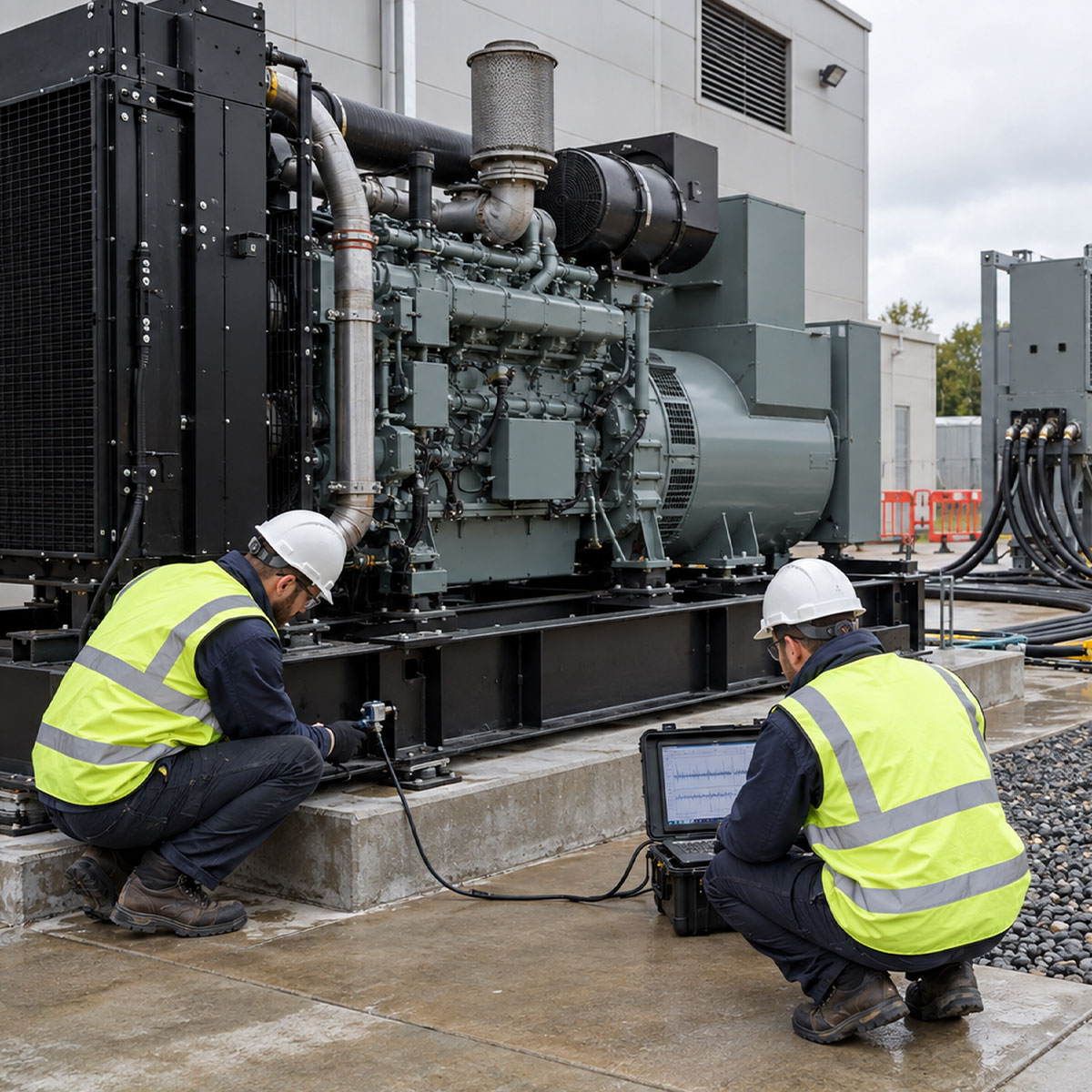
Diesel generator vibration testing measures motion at the engine, alternator, bearings, skid and supporting structure, then compares it against baselines and published criteria. It is how developing mechanical and structural faults are found while the set still runs, instead of during the outage it was supposed to cover.
Vibration analysis for GENSET health
A Generator Can Run and Still Be Warning You
Measuring vibration at key points on a generator set is one of the most reliable ways to judge mechanical condition without taking the unit apart.
Generator vibration testing starts with a baseline captured at installation or commissioning, which creates the reference. Repeat measurements then show whether the engine, alternator, bearings, coupling, skid or supporting structure is changing over time. Spectral analysis turns that movement into a fault hypothesis your maintenance team can verify, which is the difference between knowing a number is high and knowing what to open up.
Faults this testing surfaces
- Unbalance
- Misalignment
- Bearing faults
- Mechanical looseness
- Resonance
- Structural transmission
Choose the right level of visibility
3 Diesel Generator Vibration Testing Programs Compared
The right plan depends on criticality, available personnel, sensor investment, site infrastructure and how fast a change has to be seen. Most facilities start with one and move to another as the asset’s role changes.
Route-Based Data Acquisition
The entry point to generator vibration testing. A technician moves one sensor and data collector through a defined measurement route. Each point is stored for repeatable monthly, quarterly or annual trending.
- Cost-conscious entry point
- Repeatable trend history
- Needs scheduled technician time
Best Fit
Periodic screening
Temporary Multi-Sensor Acquisition
Ten to twenty temporary sensors capture synchronized data in one file, so motion can be compared across the engine, alternator, skid and structure at the same instant.
- Synchronized measurements
- Advanced troubleshooting
- Installed only when needed
Best Fit
Complex or intermittent problems
Permanent Monitoring System
A fixed sensor network collects on schedule or on demand. Automated storage and configurable alarms give continuous visibility on the sets you cannot afford to lose.
- Always-on condition history
- Alarm and threshold capability
- Long-term asset protection
Best Fit
Mission-critical GENSETs
Not sure which plan matches your risk profile? A short call about the asset, its duty and who maintains it usually settles it.

From operating context to maintenance action
5 Steps in a Generator Vibration Testing Assessment
Step 01
Define the test
Review the generator configuration, duty, service history, symptoms, criticality and the operating states available to you.
Step 02
Map measurement points
Select repeatable locations across bearings, housings, skid, isolators and structure, then document orientation and sensor setup so the next visit matches.
Step 03
Capture operating data
Collect overall levels, waveforms and spectra during agreed conditions, which may include startup, steady state and representative load.
Step 04
Interpret and prioritize
Correlate patterns across points, compare against baselines and applicable standards, then rank findings by condition and risk.
Step 05
Deliver the action plan
Receive a report that connects the evidence to recommended verification, maintenance or continued monitoring.
What the signal can reveal
Generator Faults Hide in the Pattern, Not the Number
GENSET vibration is not a single reading. Generator vibration testing works because location, direction, frequency, phase and operating state separate the likely sources, and they are what keep a team from replacing a bearing when the real problem is a soft foundation.
Unbalance
Rotational energy concentrated near running speed.
Misalignment
Coupling, angular or offset conditions that load bearings.
Bearing distress
Impacting and defect-frequency patterns that need verification.
Looseness
Movement at fasteners, fits, skid, isolators or foundation.
Resonance
Operating forces amplified by a natural frequency.
Structural vibration
Energy transferred into supports, piping or the building.
Standards-informed evaluation
5 Standards That Inform a Generator Vibration Verdict
A threshold on its own decides nothing in generator vibration testing. Generator configuration, measurement location, mounting, operating condition and the intended scope of the standard all change how a number should be read, so FPA applies the relevant guidance alongside machine history and engineering judgment rather than in place of them.
01
ISO 8528-9
Measurement and evaluation of mechanical vibration for reciprocating engine-driven alternating-current generator sets. See the ISO listing.
02
ISO 10816 / ISO 20816
Guidance for evaluating machine vibration measured on rotating and non-rotating parts, applied where relevant to the set.
03
IEC 60034-14
Factory acceptance vibration limits and measurement methods for certain rotating electrical machines.
04
ANSI / EASA AR100
Recommended practice for the repair of rotating electrical apparatus, including post-repair evaluation.
05
MIL-STD-810
Environmental engineering considerations for equipment in demanding or rugged service.
Service areas
Related Diesel Generator Vibration Testing landing pages
Louisiana
Nebraska
New Mexico
Oklahoma
Texas
Where readiness matters
Built for the Facilities That Cannot Go Dark
From periodic standby assets to continuous-duty generation, the generator vibration testing plan is shaped around the installation and the consequence of being wrong about its condition.
Healthcare
Emergency-power readiness and life-safety testing schedules.
Data centers
Fleet consistency across many identical sets.
Commercial facilities
Testing under representative load rather than an unloaded exercise.
Remote operations
Field-ready diagnostics where a return trip is expensive.
Industrial plants
Skid, piping and structural response around the set.
Frequently asked questions
Diesel Generator Vibration Testing Questions, Answered
Get in touch
Turn Uncertainty Into a Testable Condition
Tell FPA what the machine is doing, the equipment type, operating speed/load, location, and timing. The team can help identify the appropriate diagnostic or field-service scope.
Main: (832) 930-0756