
ISO 18436-2 · Category I & II · Houston, Texas
Vibration Analysis Training & Certification
Hands-on vibration training with live machinery, taught by an ASNT PdM Level III instructor and built to prepare you for ISO 18436-2 Category I and Category II vibration analyst certification. Join a public class near Houston, or bring on-site predictive maintenance training to your manufacturing plant.
4 days
8 a.m.–5 p.m. classes
Day 4
Certification exam
$1,900
Category I tuition
Since 2007
Training analysts
Why train with FPA
Vibration Analysis Training That Starts on Real Machines
Most vibration analysis training teaches you to read a spectrum on a slide. Failure Prevention Associates teaches you to find the fault on a running machine, prove it with phase and waveform data, and make the call your maintenance team will act on. Since 2007, FPA has trained mechanics, technicians, reliability engineers and dedicated analysts from refineries, chemical plants, paper mills, power generation and manufacturing across the Gulf Coast and the United States.
Our Category I and Category II courses follow the ISO 18436-2 body of knowledge, run four focused days, and finish with certification testing on Day 4. Between the lectures, you spend real time on dynamic rotating equipment: collecting data, building a route, bump testing for resonance and practicing the phase analysis that separates unbalance from misalignment, bent shafts, soft foot and looseness.
- Diagnose unbalance, misalignment, bearing defects, looseness and resonance with confidence
- Collect clean, repeatable data and recognize bad data before it leads to a bad call
- Read FFT spectra and time waveforms, and use demodulation for early bearing faults
- Set up machines and routes for a condition monitoring program that lasts
- Earn a recognized vibration analyst certification that travels with your career

Hands-on, not hands-off
Hands-On Vibration Training With Live Machinery
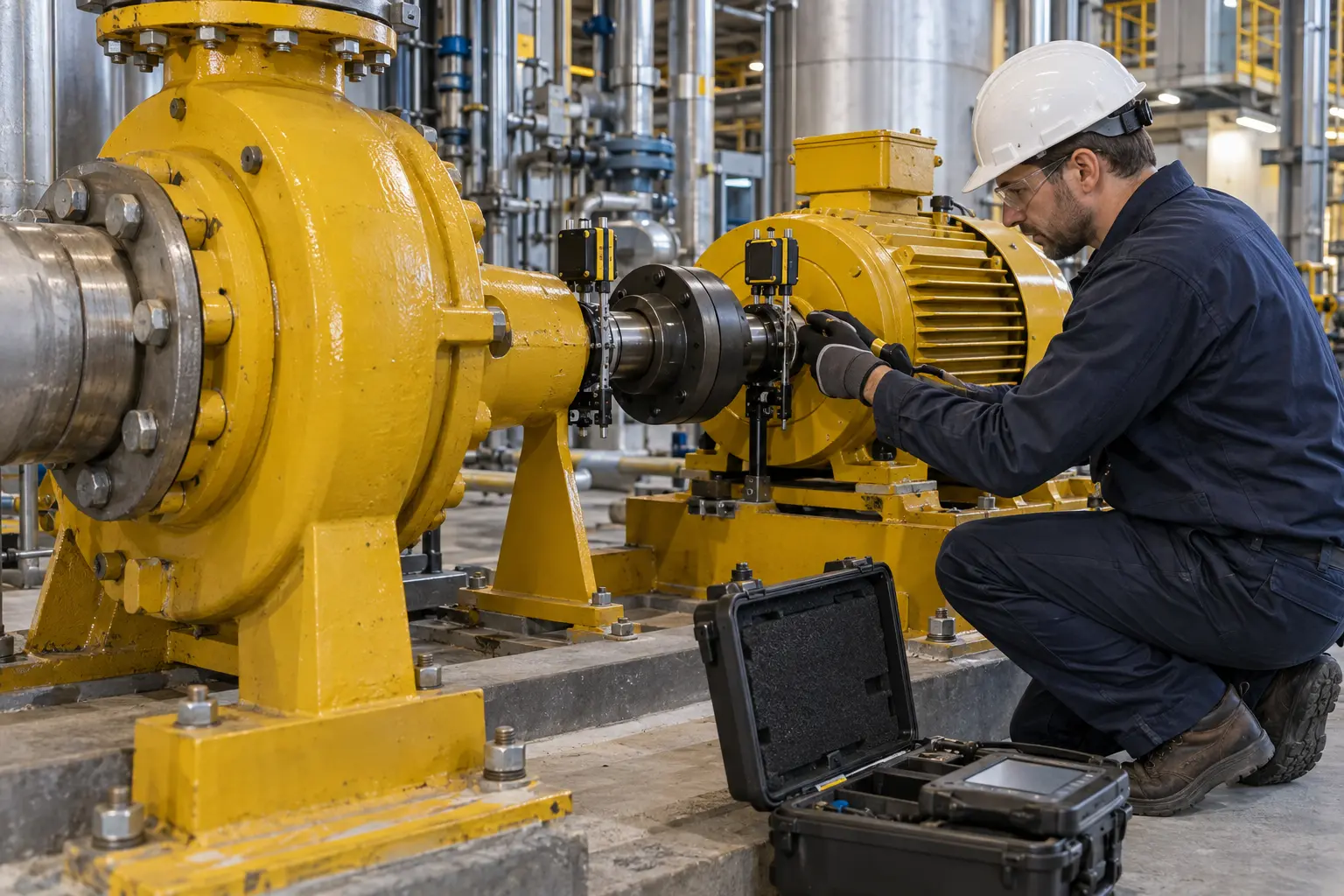
Practical exercises are built around FPA’s Houston-area mill test lab and dynamic rotating equipment, so you practice on machines that are actually running. Instead of memorizing fault charts, you measure them: you take readings, compare them with what the spectrum tells you, and confirm the diagnosis with phase. That is the difference between hands-on vibration training with live machinery and a slide-only or online course: you leave knowing how a real fault looks, sounds and trends, not just how it is drawn in a textbook.

A rolling-element bearing defect in the spectrum and waveform, the kind of fault students learn to catch months before failure.
Choose your level
Category I vs. Category II Vibration Analysis Training
Not sure where to start? Use this comparison to choose the vibration analysis training course that matches your experience and the certification you need.
Curriculum
What You’ll Learn: The 4-Day Category I Agenda
Each day runs 8 a.m. to 5 p.m. The Category I vibration analysis training course moves from the science to the field to the exam, so every concept is practiced before you are tested on it.
2027 public sessions
2027 Vibration Analysis Training Schedule & Pricing
Public classes are held in Pearland, Texas, just south of Houston. Choose a date, add the certification exam if you are ready to test, and complete registration on the next page.
| Level | Dates | Location | Class | Exam | Register |
|---|---|---|---|---|---|
| CAT I | Jan 26–29, 2027 | Pearland, TX (Houston area) | $1,900 | $330 | Register |
| CAT I | May 4–7, 2027 | Pearland, TX (Houston area) | $1,900 | $330 | Register |
| CAT I | Aug 3–6, 2027 | Pearland, TX (Houston area) | $1,900 | $330 | Register |
| CAT II | Sep 21–24, 2027 | Pearland, TX (Houston area) | $2,200 | $360 | Register |
| CAT I | Nov 2–5, 2027 | Pearland, TX (Houston area) | $1,900 | $330 | Register |
Classes run 8 a.m.–5 p.m. daily; certification testing is Day 4, 8–11 a.m. Need a date that isn’t listed, or training for a group? Request a private session.
Certification
How ISO 18436-2 Vibration Analyst Certification Works
ISO 18436-2 defines four categories of vibration analyst, each with its own training hours, experience and exam requirements. FPA’s vibration analysis training covers Category I and Category II, the two levels most plants need to build and run an in-house program.
01
Take the class
Complete the 4-day Category I or Category II course and receive the Vibration Analysis Reference Manual.
02
Pass the exam
Test on Day 4. Pass without enough experience yet and you receive a provisional certificate.
03
Log your experience
Category I requires 6 months of experience (you have one year to gain it). Category II requires 18 months cumulative.
04
Get certified, then renew
Submit evidence and receive your certificate. Recertify every 5 years by re-examination or renewal ($250 renewal fee).
ISO 18436-2 vs. ASNT Vibration Certification: Which Do You Need?
Both are recognized in U.S. industry, and FPA offers Day 4 testing for either. The difference is who certifies you and how portable the credential is. When reliability engineers and plant managers compare ISO 18436-2 vs. ASNT vibration certification, the usual deciding factors are whether the credential must follow the analyst between employers and what your customer contracts or quality program specify.
| Comparison | ISO 18436-2 | ASNT (SNT-TC-1A) |
|---|---|---|
| What it is | International standard for vibration analyst qualification and assessment | Recommended practice from the American Society for Nondestructive Testing |
| Levels | Category I–IV | Level I–III |
| Who certifies | An independent, accredited certification body | Usually your employer, under its written practice |
| Portability | Stays with you when you change employers | Typically tied to the certifying employer |
| Best for | Analysts and contractors who need a credential that is recognized worldwide | Sites whose quality program is built on SNT-TC-1A |
Check your plant’s quality program or contract to confirm which credential is required. Not sure? Ask our team.
Who it’s for
Who Should Attend Vibration Analysis Training?
This course is designed for anyone who needs to perform vibration data collection, analysis and reporting on industrial machinery. A working knowledge of mechanical equipment helps; prior vibration experience is not required for Category I.
Roles
- Vibration analysts and route-based data collectors
- Mechanical and rotating-equipment technicians
- Reliability and maintenance engineers
- Maintenance planners and supervisors
- Predictive maintenance (PdM) program owners
- Contractors who provide condition monitoring services
Industries we train
- Refining & petrochemical
- Chemical processing
- Pulp & paper
- Power generation
- Oil & gas
- Water & wastewater
- Manufacturing
- Food & beverage
- Mining & aggregates
Your instructor
Learn From Dr. Karl Hoffower, ASNT PdM Level III

FPA classroom instruction: every concept is tied back to real machinery.
Dr. Karl Hoffower founded Failure Prevention Associates in 2007 to make predictive and condition-based maintenance practical for industrial plants. He holds the ASNT PdM Level III credential with dual endorsement in vibration analysis and thermal/infrared testing, and he leads FPA’s vibration analysis training program.
Students learn from a practitioner, not a presenter. FPA’s day-to-day field work shapes the course: fewer slides, more running equipment, and real case histories from plants across Texas, Louisiana, Oklahoma, and beyond.
- ASNT PdM Level III
Vibration analysis + thermal/infrared - Founder, FPA
Training analysts since 2007 - Published author
Condition-based maintenance article in CompressorTech² (Oct 2016)
For plants & teams
On-Site Predictive Maintenance Training for Manufacturing Plants & Industrial Teams
When you need to certify a whole crew, it is usually faster and cheaper to bring the instructor to you. FPA delivers on-site Category I and Category II vibration analysis training at plants across Texas, Louisiana, New Mexico and beyond, and we use your own machines and your own data collector wherever possible.
Need more than vibration? Our on-site predictive maintenance training for manufacturing plants can pair vibration analysis with infrared thermography and other condition monitoring courses, so your reliability, maintenance and operations staff build one PdM program together instead of learning in silos.
- Practicals on your critical assets, so findings can turn into work orders
- Training built around your analyzer and software
- Group certification testing on site, with no travel costs for your team
- Pair with a skills-gap assessment to target exactly what your team is missing

Texas · Louisiana · New Mexico
Training Vibration Analysts Across the Gulf Coast and Southwest
Our hands-on lab is in the Houston area, and that is where public classes are held. Analysts travel in from the Permian Basin, Corpus Christi, the Golden Triangle, Dallas–Fort Worth, El Paso, Baton Rouge and beyond. For larger teams, it often makes more sense for FPA to come to you: we regularly travel to plants throughout Texas, Louisiana and New Mexico to train and certify crews on site.
Looking for options near you? See vibration analysis training in Texas for regional details, or ask about on-site training at your plant.